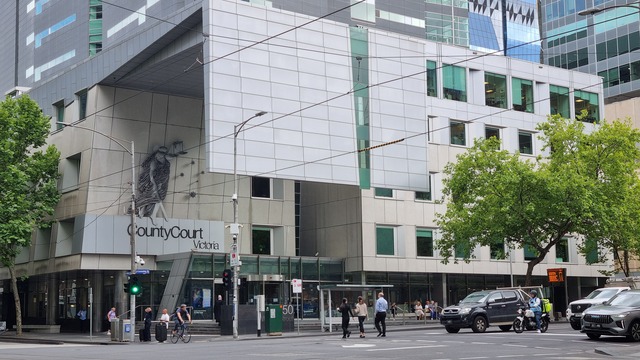
Police conduct had “significantly” contributed to a Clyde North man with an intellectual disability selling guns and cocaine to an undercover cop over an eight-month period, a judge has stated.
Bilal Jussab Mpinganjira pleaded guilty at the Victorian County Court to offences including trafficking a commercial quantity of cocaine, as well as disposing a traffickable quantity of firearms.
He was also charged with being a prohibited person possessing an Adler B230 shotgun, Ruger precision rifle, TEC-9-style homemade semi-automatic pistol and Beretta handgun.
Other offences were possessing an unregistered sawn-off bolt-action rifle, failing to comply with an order to assist police, committing an indictable offence on bail and possessing $8000 in suspected proceeds of crime.
In late 2022, Mpinganjira was introduced to the covert operative who asked him if he had any connections for ‘rack’ (cocaine).
The accused replied that he was the connection, and that he sold in minimums of 250 grams. A full kilogram would cost $200,000, he told the operative.
Between December 2022 and August 2023, the operative rang or messaged Mpinganjira, requesting cocaine and guns.
It led to seven sales totalling 655.1 grams of coke (400 grams pure) during meet-ups across Melbourne and the South East.
Mpinganjira was arrested by police at the last rendezvous at Drummond Street, Oakleigh – a sale of nearly 500 grams that pushed his offending into commercial trafficking and a maximum of 25 years jail time.
There were a further four sales of a range of guns and ammunition over the eight months.
On 17 March, sentencing judge Duncan Allen noted that the police’s conduct was legitimate but contributed “significantly” to the 27-year-old Mpinganjira’s trafficking.
The undercover officer initiated most of the transactions, by requesting cocaine and guns from the “middle-man”.
Despite being under surveillance for eight months, there was no evidence that he’d trafficked drugs or guns to anyone else except the undercover officer, the judge noted.
If not for the ongoing relationship, he would have been likely charged trafficking in a smaller quantity, Judge Allen stated.
This didn’t excuse the man’s offending, but may be of some mitigation, the judge said.
Mpinganjira’s low IQ of 59-64, lack of prior convictions, early guilty plea, childhood trauma, acquired brain injury and his cocaine addiction at the time were also noted.
Since his remand, his “powerful desire” for reform and strong family support including paying for private therapy added up to “excellent” rehabilitation prospects, the judge said.
Judge Allen set a lower-than-standard non-parole period, saying it was in the community interest to release Mpinganjira under parole supervision at the earliest possible stage.
He was jailed for five-and-a-half years, with a three-year non-parole period.
The term included 954 days already spent in pre-sentence remand.
Mpinganjira faced potential deportation as a result of his jail sentence, the court was told.
A prosecuting lawyer foreshadowed they would apply for a pecuniary penalty order – in which Mpinganjira would have to repay the money received from the transactions.