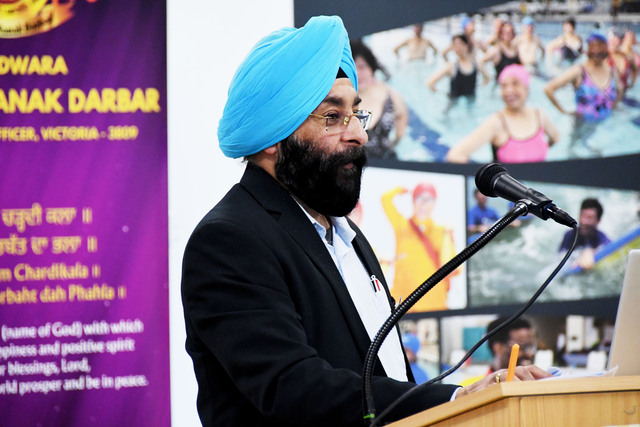
Dr Harpreet Singh Kandra often recalls the story of his nearly fatal drowning when he was a boy.
The community volunteer and professor at Federation University, remembers the moment he lost his footing in a sacred body of water in India, he remembers battling the depth of the water as he tried his best to stay up before a stranger saved him.
Likewise, when he began to learn to swim as an adult in Australia, the image of this traumatic experience relayed in his mind.
“It actually left a very scary impression on my mind,” said the professor.
“Even now, when I do basic swimming skills and I get into water, that scene comes into my mind again.”
Dr Kandra’s experience, however, is not unique.
For many migrants living in Australia, basic swimming skills and water safety awareness is often overlooked.
The Royal Life Saving Society (RLS) 2025 national drowning report, highlighted that from 1 July 2024 to 30 June 2025, 357 fatal drownings were reported — a third of which were individuals born overseas.
The numbers reported were confronting, with a 27 per cent increase in a 10 year average.
Those born overseas accounted for 37 per cent of all drownings in the last decade and are 5 times more likely to drown, according to Life Saving Victoria (LSV).
The report also found that those who were most disadvantaged, such as those who come from low-socioeconomic locations are twice more likely to drown.
While those over 65 are also most at risk.
Both RLS and LSV asserts these numbers are compounded by multiple existing barriers, from accessible language limitations, to differing cultural, religious, social and financial barriers.
It also outlined that while exposure to water is evolving, swimming skills are in rapid decline.
David Holland, LSV’s strategic advisor and D&I community outreach, told Star News that this can be attributed to low participation in aquatics activities both in country of origins as well as upon arrival in Australia.
Many born overseas don’t see basic swimming skills as priority.
Mr Holland said that while these barriers are still evident, targeted programs and resources have sought to address them.
“LSV, over the last four years of regular engagement with seniors within CALD (culturally and linguistically diverse) and non-CALD communities, has seen an enthusiastic and positive response to participation in water safety activities once seniors are actually approached and invited to do so,” he said.
“LSV has engaged over 4,600 seniors through 172 water safety focussed, beach, pool and classroom activities since 2022.”
After his fearful encounter with the water, Dr Kandra began a fresh journey as an adult and through his own success, has since been able to encourage and inspire hundreds from the Casey’s multicultural community to take up adult learning.
Dr Kandra was also heavily impacted by drowning fatalities within his own community, including four individuals from Casey who were travelling from India.
Mr Holland says that when tragedies occur in the water, it can often bring awareness.
“Drowning tragedies over recent years appear to have further raised community awareness and rightful concern on the issue of adults from CALD communities having low water safety knowledge and aquatic ability swimming,” he said.
Beginning in July 2024, Dr Kandra and his colleagues from the Officer Sikh Temple initiated a ‘safely engaging with water’ program which was officially launched on World Drowning Prevention Day.
“The key focus of this program is not to reach water safety, but rather, to connect people with water so that people can understand what good swimming can do to our lifestyles and to our well being,” said the professor.
Since the program began 18 months ago, Dr Kandra said that over 300 adults have graduated with lifesaving aquatic skills.
The program also leverages on the social and lifestyle aspects of swimming, ensuring that non-swimmers who are born overseas understand that being knowledgeable on key swimming skills is also an essential part of being around large bodies of water.
Dr Kandra, likens it to learning how to drive.
“When a new person relocates to Australia, whether they’re a student or a first generation migrant, they know in the first week to start understanding the driving rules in Australia and they take a few driving lessons and they start taking some tests and then they get a license,” he said.
“They do understand that driving is very important for them to survive in Australia in the same way they look at other things. But when it comes to swimming, it’s not on their lists of priorities.
It’s not that they don’t want to learn swimming but also because swimming has never been in the curriculum of the education that is imparted in some countries.
“We have to tell the multicultural communities that water is fun.
“If you get into the water with your family, you can have quality time and you can also do things like water sports and swimming. It’s good for your health.
“If you go on a holiday and if you know swimming, you can enjoy the beaches.
“So rather than just taking selfies of the beaches, you actually enjoy the beach and you enjoy the waters there.
“And once you enjoy the good quality of water in the Australian beaches, you understand the significance of environment and sustainability.
“So these are the things that have not been told, that have not been used as a motivator for migrants.”
Both Dr Kandra and RLS have equally emphasised the importance of instilling change in the mindsets and attitudes surrounding swimming, with many migrants “fearing” or holding an entrenched phobia of the water — a fear that can transfer to younger generations.
“Often, when our kids go to schools, the school asks for a consent that their child should be allowed to go to swim centers, and learn swimming,” said Dr Kandra.
“A lot of parents do not provide that consent.
“In certain cases, parents do not provide the consent and as a result, their kids do not engage with swimming for several reasons.
“This is where the parents have to ensure that they build swimming skills in their children.
“It is a vital lifesaving skill and multicultural parents should not ignore this, they should encourage it.
“Because every life that is saved in the water, is an Olympic gold in itself.”
“Or much bigger than an Olympic gold.”
The adult swimming program has since partnered with multiple local swimming pools, from Casey, Cardinia and Dandenong and welcomes further keen participation from the community.